
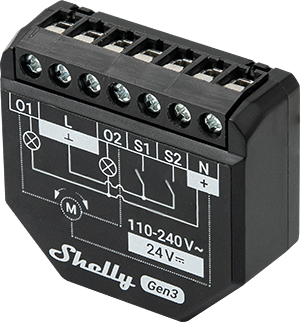
Device identification
-
Device name: Shelly 2PM Gen3
-
Device model: S3SW-002P16EU
-
Device SSID: Shelly2PMG3-XXXXXXXXXXXX
-
BLE Model ID: 0x1005
Short description
Shelly 2PM Gen3 is a small form factor 2-channel smart switch with power measurement and cover control, which allows remote control of electric appliances through a mobile phone, tablet, PC, or home automation system. It can work standalone in a local Wi-Fi network or it can also be operated through cloud home automation services. The device also has improved processor and increased memory compared to its predecessor. The device supports Venetian blinds.
Shelly 2PM Gen3 can be accessed, controlled and monitored remotely from any place where the User has internet connectivity, as long as the device is connected to a Wi-Fi router and the Internet.
It can be retrofitted into standard electrical wall boxes, behind power sockets and light switches or other places with limited space.
Shelly 2PM Gen3 has embedded Web Interface which can be used to monitor and control the device, as well as adjust its settings.
Main features
-
Smart Switch with Power Measurement: Acts as a smart switch with the added capability of measuring power consumption, allowing you to monitor the energy usage of connected appliances.
-
Compact Design: Designed as a small form factor switch, making it suitable for retrofitting into standard electrical wall boxes, behind power sockets, light switches, or other confined spaces.
-
Remote Control: Enables remote control of electric appliances via a mobile phone, tablet, PC, or home automation system.
-
Local and Cloud Control: Can function independently in a local Wi-Fi network and can also be operated through cloud home automation services.
-
Improved Processor and Memory: Upgraded with an improved processor and increased memory for enhanced performance.
-
Remote Access: Allows remote access, control, and monitoring from any location with internet connectivity, provided the device is connected to a Wi-Fi router and the internet.
-
Embedded Web Interface: Features an embedded web interface for monitoring, control, and adjustment of settings.
-
BLE Gateway: Bridge between your Shelly BLU devices and the wider Shelly ecosystem. It receives Bluetooth signals and sends them to the cloud or locally to another non-bluetooth device.
-
Wi-Fi Range extender for IoT devices: A Wi-Fi extender is employed to expand the reach of your Wi-Fi network by receiving your current Wi-Fi signal, enhancing its strength, and then transmitting the enhanced signal over a wider area.
-
Scripting: https://shelly-api-docs.shelly.cloud/gen2/ComponentsAndServices/Script
-
Wide range of integrations: The device can be integrated with 3rd party home systems, documented HTTP API, MQTT(s), Web Hooks over HTTP and HTTPS, UDP
-
KNX: Supports KNXnet/IP communication (Switch mode only with firmware 1.5.0 and later).
-
Schedules: Allows scheduling of complex operations to be executed in predefined time window. Users can specify time windows based on date, time of day, weekdays, hours, minutes and seconds.
-
Virtual Components: https://shelly-api-docs.shelly.cloud/gen2/DynamicComponents/Virtual/
-
Venetian blinds mode: The Device enables remote control of motorized blinds, roller shutters, venetian blinds, awnings, etc. It measures power consumption of the connected device. It is recommended to use only motors with electronic or mechanical limit switches. The motor limit switches must be set correctly before connecting the Device to the motor.
-
Controls position of blinds, rollers, shades, venetian blinds, etc.
-
Controls tilt position of the slats of venetian blinds
-
Use cases
-
Appliance Control: Use it to remotely control and automate the operation of various electric appliances such as lights, fans, or other devices.
-
Power Monitoring: Monitor the power consumption of connected appliances in real-time. This is useful for understanding energy usage patterns and promoting energy efficiency.
-
Home Automation: Integrate the Shelly 2PM Gen3 into your home automation system to create custom scenes and schedules for your devices.
-
Energy Efficiency: Leverage the power measurement feature to identify energy-hungry appliances and make informed decisions to improve overall energy efficiency in your home.
-
Remote Monitoring: Keep an eye on your devices even when you're away from home. The remote access feature allows you to monitor and control connected appliances from anywhere with internet connectivity.
Integrations
Amazon Alexa supported capabilities
Yes
Google Smart Home supported traits
Yes
Samsung SmartThings supported capabilities
Yes
Simplified internal schematics
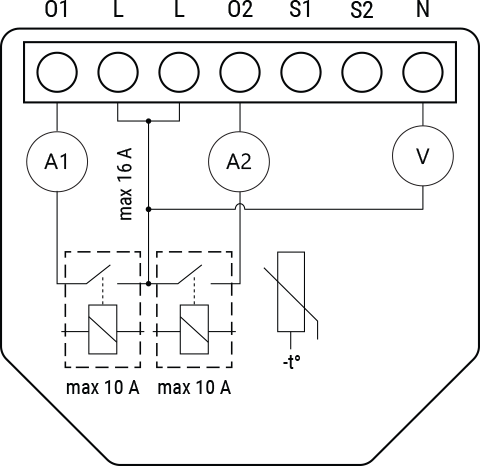
Device electrical interfaces
Inputs
-
2 switch/button inputs on screw terminal: S1 and S2
-
3 power supply inputs on screw terminals: 1 N (+) and 2 L (Ʇ)
Outputs
-
2 relay outputs with power measurement on screw terminal
Add-on interface
-
Shelly proprietary serial interface
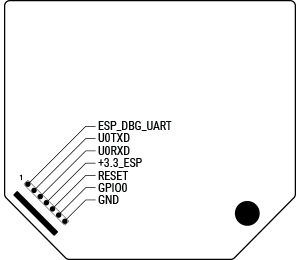
⚠CAUTION! High voltage on the add-on interface when the Device is powered!
Connectivity
-
Wi-Fi
-
Bluetooth
Safety functions
-
Overheating protection
-
Overvoltage protection
-
Overcurrent protection
-
Overpower protection
-
Obstacle detection (cover mode)
-
Safety switch (cover mode)
Supported load types
User interface
Inputs
Specifications
|
Quantity |
Value |
|---|---|
|
Physical |
|
|
Size (HxWxD): |
37x42x16 ±0.5 mm / 1.46x1.65x0.63 ±0.02 in |
|
Weight: |
30 g / 1.06 oz |
|
Screw terminals max torque: |
0.4 Nm / 3.5 lbin |
|
Conductor cross section: |
0.5 to 4 mm² / 20 to 11 AWG (solid, stranded, and bootlace ferrules) |
|
Conductor stripped length: |
6 to 7 mm / 0.24 to 0.28 in |
|
Mounting: |
Wall box |
|
Shell material: |
Plastic |
|
Shell color: |
Black |
|
Terminals color: |
Black |
|
Environmental |
|
|
Ambient working temperature: |
-20°C to 40°C / -5°F to 105°F |
|
Humidity: |
30% to 70% RH |
|
Max. altitude: |
2000 m / 6562 ft |
|
Electrical |
|
|
Power supply: |
110 - 240 V~ / 24 V⎓ ±10% |
|
Power consumption: |
< 1.4 W |
|
External protection: |
Tripping characteristic B or C,
|
|
Output circuits ratings |
|
|
Max. switching voltage: |
|
|
Max. switching current AC: |
10 A (per channel), 16 A (total), 18 A (total peak) |
|
Max. switching current DC: |
10 A |
|
Sensors, meters |
|
|
Voltmeter (AC): |
Yes |
|
Ammeter (AC): |
Yes |
|
Internal-temperature sensor: |
Yes |
|
Radio |
|
|
Wi-Fi |
|
|
Protocol: |
802.11 b/g/n |
|
RF band: |
2412 - 2472 МHz |
|
Max. RF power: |
< 20 dBm |
|
Range: |
Up to 30 m / 100 ft indoors and 50 m / 160 ft outdoors
|
|
Bluetooth |
|
|
Protocol: |
4.2 |
|
RF band: |
2402 - 2480 MHz |
|
Max. RF power: |
< 4 dBm |
|
Range: |
Up to 10 m / 33 ft indoors and 30 m / 100 ft outdoors
|
|
Microcontroller unit |
|
|
CPU: |
ESP-Shelly-C38F |
|
Flash: |
8MB |
|
Firmware capabilities |
|
|
Schedules: |
20 |
|
Webhooks (URL actions): |
20 with 5 URLs per hook |
|
Scripting: |
Yes |
|
MQTT: |
Yes |
Basic wiring diagrams
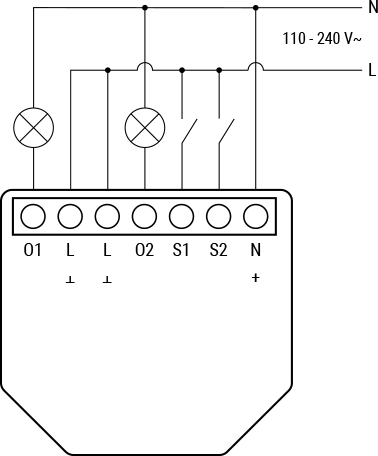
Dual-channel switch mode, AC power supply |
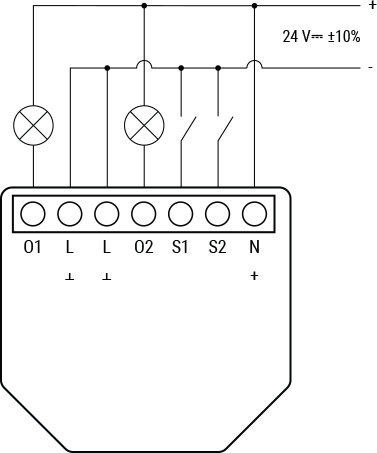
Dual-channel switch mode, DC power supply |
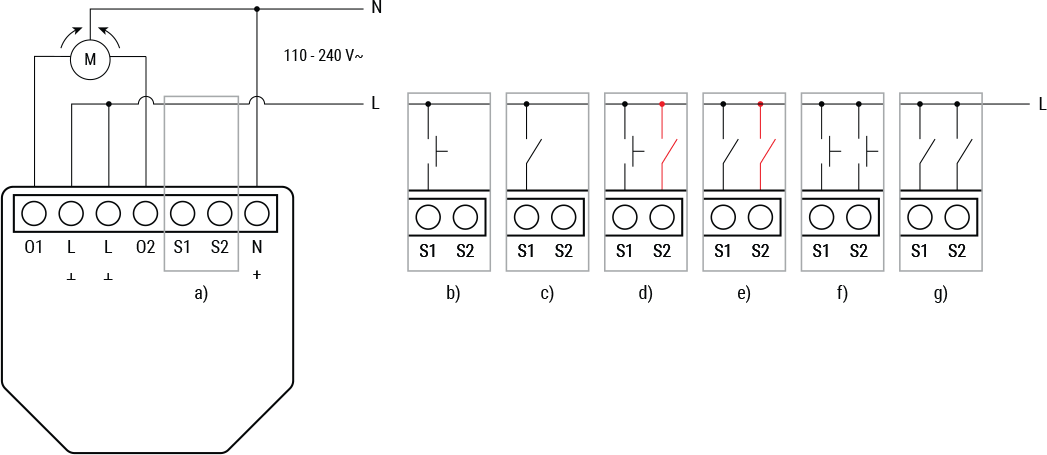
Cover mode |
|
Legend
|
Terminals |
Wires |
||
|---|---|---|---|
|
O1, O2: |
Load circuit output terminals |
N: |
Neutral wire |
|
L: |
Live terminal (110-240 VAC) |
L: |
Live wire (110-240 V~) |
|
S1, S2: |
Switch input terminals |
+: |
24 V⎓ positive wire |
|
S1, S2 |
Switch input terminals |
- |
24 V⎓ negative wire
|
|
+: |
24V⎓ positive terminal |
|
|
|
Ʇ: |
24V⎓ negative terminal |
|
|
Shutter configuration instructions
As a cover controller, the Device can work in 3 modes: detached, single input, or dual input.
Detached mode
In detached mode, the Device can be controlled through its Web Interface and the Shelly Smart Control application only. Even if buttons or switches are connected to the Device, they will not be allowed to control the motor rotation in detached mode.
If you want to use the device in detached mode, connect the device as shown as a) on the Wiring diagram.
Single mode
In single mode, the Device can be controlled through one button or one switch.
If you want to use the device in single input mode connect the device as shown as b) on the Wiring diagram.
If the input is configured as a button in the device settings, each button press cycles open, stop, close, stop, etc.
If the input is configured as a switch each switch toggle cycles open, stop, close, stop, etc.
Safety switch functionality
In single input mode the Device provides safety switch functionality. To utilize it, connect the device as shown as d) on the Wiring diagram for a button input or as e) on the Wiring diagram for a switch input.
The safety switch can be configured to:
-
Stop the movement until the safety switch is disengaged or until a command is sent and, if allowed in the Device settings, the movement is resumed in the opposite direction until the end position is reached.
-
Stop and immediately reverse the movement until the end position is reached. This option requires reverse movement to be allowed in the Device settings.
The safety switch can also be configured to stop the movement in only one of the directions or in both.
Dual mode
In dual mode, the Device can be controlled using two button or two switch.
If you want to use the Device in dual input mode, connect the Device as shown as f) on the Wiring diagram for button inputs or as g) on the Wiring diagram for switch inputs.
In case the inputs are configured as buttons:
-
Pressing the button when the cover is static moves the cover in the corresponding direction until the endpoint is reached.
-
Pressing the button for the same direction while the cover is moving stops the cover.
-
Pressing the button for the opposite direction, while the cover is moving, reverses the cover movement until the endpoint is reached.
In case the inputs are configured as switches:
-
Turning a switch on moves the cover in the corresponding direction until an endpoint is reached.
-
Turning the switch off stops the cover movement. If both switches are turned on, the Device will respect the last engaged switch. Turning off the last engaged switch stops the cover movement, even if the other switch is still on.
To move the cover in the opposite direction, the other switch has to be turned off and on again.
Obstacle detection
The Device can detect obstacles. If an obstacle is present, the cover movement will be stopped and, if configured so in the Device settings, reversed until the endpoint is reached. Obstacle detection can be enabled or disabled for either one direction or for both.
Troubleshooting
-
Ensure that the device is properly powered:
-
Check power cables, outlets, and any power indicators on the device.
-
-
Inspect Connections:
-
Verify that all connections, including cables and wiring, are secure and properly seated. Loose connections can lead to functionality issues.
-
-
Review Device Settings:
-
If applicable, check and review the device settings. Ensure that configurations are correct and match your intended use.
-
-
Update Firmware/Software:
-
Check if there are any available firmware or software updates for the device. Keeping the device up-to-date can resolve known issues and improve performance.
-
-
Restart or Reboot:
-
Sometimes, a simple restart can resolve temporary glitches. Turn off the device, wait a few seconds, and then power it back on.
-
-
Check Network Connection:
-
If the device is connected to a network, ensure that the network settings are correct. Test the network connection and consider restarting routers or switches if needed.
-
-
Inspect Physical Components:
-
Physically inspect the device for any signs of damage, overheating, or unusual behavior.
-
-
Check Compatibility:
-
Ensure that the device is compatible with other components in your system, including hardware and software. Incompatibility issues can lead to malfunctions.
-
-
Monitor Environmental Factors:
-
Consider environmental factors such as temperature and humidity.
-
-
Inspect Power Supply Quality:
-
Poor power quality, including voltage spikes or fluctuations, can affect device performance. Consider using a surge protector or voltage regulator if needed.
-
*These are general troubleshooting steps, and the specific steps may vary based on the type of device or issue you are facing. If the issue persists and you are unable to resolve it, consider reaching out to our technical customer support.
Shelly Smart Control
Shelly Web user interface
Components and APIs
Printed user guide
Compliance
-
Shelly 2PM Gen3 multilingual EU declaration of conformity 272 2026-03-13.pdf
-
Shelly 2PM Gen3 UK PSTI ACT statement of compliance 272 2026-03-13.pdf
-
Shelly 2PM Gen3 UKCA declaration of conformity 272 2026-03-13.pdf