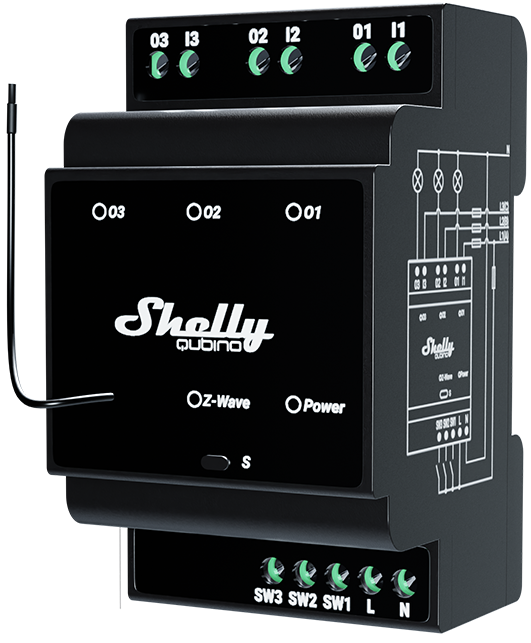
Device: Wave Pro 3 (US)
US Part number/Ordering Code: QPSW-0A3X16US
Z-Wave Product type ID: 0x0002
Z-Wave Product ID: 0x0091
Z-Wave Manufacturer: Shelly Europe
Z-Wave Manufacturer ID: 0x0460
Terminology
Device - In this document, the term “Device” is used to refer to the Shelly Qubino device that is a subject of this guide.
Gateway (GW) - A Z-Wave™ gateway, also referred to as a Z-Wave™ controller, Z-Wave™ main controller, Z-Wave™ primary controller, or Z-Wave™ hub, etc., is a device that serves as a central hub for a Z-Wave™ smart home network. The term “gateway” is used in this document.
S button - The Z-Wave™ Service button, located on Z-Wave™ devices and is used for various functions such as adding (inclusion), removing (exclusion), and resetting the device to its factory default settings. The term "S button" is used in this document.
Adding/Inclusion - The process of adding Z-Wave device to a Z-Wave network - gateway. The words included, added, etc.are used in this regard.
Removing/Exclusion - The process of removing Z-Wave device from a Z-Wave network - gateway. The words excluded, removed, etc.are used in this regard.
Short description
The Device is a DIN rail mountable 3-channel smart switch with potential-free contacts. It controls the on/off function for three independent electrical devices with a load up to 16 A per channel (48 A in total). It is compatible with switches (default) and push-buttons.
Switch/push-button connected to input terminal SW (SW1)
If the SW (SW1) is configured as a switch (default), each toggle of the switch will change the output O (O1) state to the opposite state - on, off, on, etc. If the SW (SW1) is configured as a push-button in the Device settings, each press of the push-button will change the output O (O1) state to the opposite state - on, off, on, etc.
Switch connected to input terminal SW (SW1)
If the SW (SW1) is configured as a switch (default), each toggle of the switch will change the output O (O1) state to the opposite state - on, off, on, etc.
Change switch position once: Change the state of the output O (O1) state to the opposite state and send the command to the associated devices in associated groups 2 and 3 (check chapter Z-Wave Association).
Switch-memory connected to input terminal SW (SW1)
If the SW (SW1) is configured as a switch-memory, than:
Switching to Close switch-memory contact: Change the state of the output state O (O1) to the On state and send command to the associated devices in associated groups 2 and 3 (check chapter Z-Wave Association)
Switching to Open switch-memory contact: Change the state of the output state O (O1) to the Off state and send command to the associated devices in associated groups 2 and 3 (check chapter Z-Wave Association)
Push-button connected to input terminal SW (SW1)
If the SW (SW1) is configured as a push-button in the Device settings, each press of the push-button changes the output state O (O1) to opposite - ON, OFF, ON, etc.
Short press: Change the state of the output state O (O1) to the opposite one and send command to the associated devices in associated groups 2 and 3 (check chapter Z-Wave Association)
Hold: Send command to the associated devices in associated group 3 (check chapter Z-Wave Association)
Release: Send command to the associated devices in associated group 3 (check chapter Z-Wave Association)
Switch/push-button connected to input terminal SW2
If the SW2 is configured as a switch (default), each toggle of the switch will change the output O2 state to the opposite state - on, off, on, etc. If the SW2 is configured as a push-button in the Device settings, each press of the push-button will change the output O2 state to the opposite state - on, off, on, etc.
Switch connected to input terminal SW2
If the SW2 is configured as a switch (default), each toggle of the switch will change the output state O2 to the opposite state - ON, OFF, ON, etc.
Change switch position once: Change the state of the output state O2 to the opposite one and send command to the associated devices in associated groups 4 and 5 (check chapter Z-Wave Association).
Switch-memory connected to input terminal SW2
If the SW2 is configured as a switch-memory, than:
Switching to Close switch-memory contact: Change the state of the output state O2 to the On state and send command to the associated devices in associated groups 4 and 5 (check chapter Z-Wave Association)
Switching to Open switch-memory contact: Change the state of the output state O2 to the Off state and send command to the associated devices in associated groups 4 and 5 (check chapter Z-Wave Association)
Push-button connected to input terminal SW2
If the SW2 is configured as a push-button in the Device settings, each press of the push-button changes the output state O2 to opposite - ON, OFF, ON, etc.
Short press: Change the state of the output state O2 to the opposite one and send command to the associated devices in associated groups 4 and 5 (check chapter Z-Wave Association)
Hold: Send command to the associated devices in associated group 4 (check chapter Z-Wave Association)
Release: Send command to the associated devices in associated group 5 (check chapter Z-Wave Association)
Switch/push-button connected to input terminal SW3
If the SW3 is configured as a switch (default), each toggle of the switch will change the output O3 state to the opposite state - on, off, on, etc. If the SW3 is configured as a push-button in the Device settings, each press of the push-button will change the output O3 state to the opposite state - on, off, on, etc.
Switch connected to input terminal SW3
If the SW3 is configured as a switch (default), each toggle of the switch will change the output state O3 to the opposite state - ON, OFF, ON, etc.
Change switch position once: Change the state of the output state O3 to the opposite one and send command to the associated devices in associated groups 6 and 7 (check chapter Z-Wave Association)
Switch-memory connected to input terminal SW3
If the SW3 is configured as a switch-memory, than:
Switching to Close switch-memory contact: Change the state of the output state O3 to the On state and send command to the associated devices in associated groups 6 and 7 (check chapter Z-Wave Association)
Switching to Open switch-memory contact: Change the state of the output state O3 to the Off state and send command to the associated devices in associated groups 6 and 7 (check chapter Z-Wave Association)
Push-button connected to input terminal SW3
If the SW3 is configured as a push-button in the Device settings, each press of the push-button changes the output state O3 to opposite - ON, OFF, ON, etc.
Short press: Change the state of the output state O3 to the opposite one and send command to the associated devices in associated groups 6 and 7 (check chapter Z-Wave Association)
Hold: Send command to the associated devices in associated group 6 (check chapter Z-Wave Association)
Release: Send command to the associated devices in associated group 7 (check chapter Z-Wave Association)
Main applications
Residential
MDU (Multi Dwelling Units - apartments, condominiums, hotels, etc.)
Light commercial (small office buildings, small retail/restaurant/gas station, etc.)
Government/municipal
University/college
Farming
Integrations
Shelly Qubino Wave devices are developed on the world's leading technology for smart homes – Z-Wave.
This means Shelly Qubino Wave works with all certified gateways supporting Z-Wave communication protocol.
To make sure the functions of Shelly Qubino Wave products are supported on your gateway, we are regularly executing compatibility tests of our devices with different Z-Wave gateways.
Simplified internal schematics
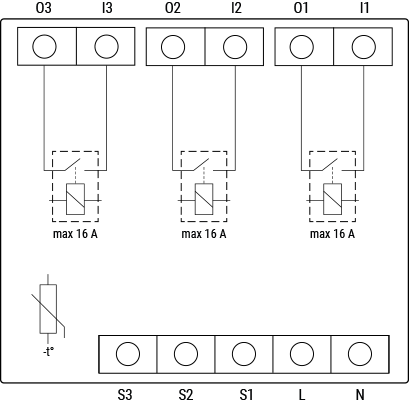
Device electrical interfaces
Inputs
3 switch/push-button inputs on screw terminal 3 potential-free contact relay inputs on screw terminal 2 power supply inputs on screw terminals: N , L
Outputs
3 potential-free contacts relay outputs on screw terminal
S button and operating modesSettings mode:Is required to start the desired procedure, for example: adding (inclusion (*not available for Long Range devices)), removing (exclusion), factory reset, etc. It has a limited operating time. After completing the procedure in Setting mode, the Device automatically switches to Normal mode. Entering Setting mode:Press and hold the S button on the Device until the LED turns solid blue.An additional quick press on the S button changes the menu in an infinite loop.The Menu LED status has a timeout of 10s before entering again into Normal mode. S button’s functionsManually adding the Device to a Z-Wave network (*not available for Long Range inclusion)Manually removing the Device from a Z-Wave networkFactory Reset the Device
LED Signalisation
Click to see LED signalisation
Zwave LED LED type: RGB dimmable General rulesSwitching between Normal and Settings mode is done by press and hold the S button.Solid LED means that you are in the Settings mode (this is not valid for Plugs). Once in settings mode, switch to normal mode goes automatically after 10s.If the LED is not in Alarm mode, it will turn off after a timeout of 30min. Pressing the S button or power cycling the Device will wake the LED for 30min.During module boot up LED will blink in mode 5 (0,2s On blue/0,2s On red) for 4-5 s.Normal mode LED status: Normal mode is defined by stable device function that can remain for an infinite time.
Normal mode
Removed/ExcludedThe LED will be blinking blue in Mode 1 for 30min after every power cycle and 10min after S button pressed.

Added/IncludedThe LED will be blinking green in Mode 1 for 30min after every power cycle and 10min after S button pressed.

Settings in progress
Factory reset and reboot
During factory reset, the LED will turn solid green for approx. 1sec, then the blue and red LED will be blinking 0,1s On / 0,1s Off for about 2sec.
Adding / Removing
During adding or removing, the LED will be blinking blue in Mode 2.

OTA firmware updating
During the OTA update, the LED will be blinking blue and red in Mode 2.

Checking AC or DC voltage power supply
During checking the power supply, the LED will be blinking blue and red in Mode 5.

Settings mode with S button
Adding / Removing menu selected (*adding not available for Long Range inclusion)
When the menu is selected the LED will be on blue, for maximum of 10 seconds.
Adding / Removing menu - while pressing S- button - Add/Remove process selected (*adding not available for Long Range inclusion)
When the menu is executing the LED will be blinking blue in Mode 3.

Factory reset menu selected
When the menu is selected the LED will be on red, for maximum of 10 seconds.
Factory reset - while pressing S - button - Factory reset process selected
When the menu is executing the LED will be blinking red in Mode 3.

Alarm Mode
Overheat detected
The LED will be blinking red in Mode 4

Mode 4 / 2x (LED 0,2s On / 0,2s Off) + 2s Off repeating sequence
Power LED
LED type: Red
The LED will be redsolid if power supply is connected.
Output (O, O1, O2,…) LED
LED type: Red
The LED will be red solid if the Output relay is closed.
Removed/Excluded
The LED will be blinking blue in Mode 1 for 10 min after every power cycle and 10 min after S button pressed.

Added/Included
The LED will be blinking green in Mode 1 for 10 min after every power cycle and 10 min after S button pressed.

Settings in progress
Factory reset and reboot
During factory reset, the LED will turn solid green for approx. 1sec, then the blue and red LED will be blinking 0,1s On, 0,1s Off for about 2sec.
Adding / Removing
During adding or removing, the LED will be blinking blue in Mode 2.

Firmware updating OTA
During the OTA update, the LED will be blinking blue and red in Mode 2.

Checking power supply 230 V AC frequency or 24 V DC voltage
During checking the power supply, the LED will be blinking blue and red in Mode 5.

Settings mode with S button
Adding / Removing menu selected
When the menu is selected the LED will be on blue, for maximum of 10 seconds.
Adding / Removing menu - while pressing S- button - Add/Remove process selected
When the menu is executing the LED will be blinking blue in Mode 3.

Factory reset menu selected
When the menu is selected the LED will be on red, for maximum of 10 seconds.
Factory reset - while pressing S - button - Factory reset process selected
When the menu is executing the LED will be blinking red in Mode 3.

Alarm Mode
Overheat detected
The LED will be blinking red in Mode 4 2x - 0,2s On 0,2s Off 0,2s On 0,2s Off 2s Off and repeating this sequence

LED blinking modes
Click to see the LED blinking modes
LED blinking modes
Mode 1
0,5s On/2s Off
Mode 2
0,5s On/0,5s Off
Mode 3
0,1s On/0,1s Off
Mode 4
(1x to 6x - 0,2s On/0,2s Off) + 2s Off
Mode 5
0,2s On blue/0,2s On red
Specifications
Power supply
110 - 240 V AC 50/60 Hz
Power consumption
< 0.3W
Power measurement [W]
No
Max. switching voltage AC
240 V
Max. switching current AC
16 A per channel, 48 A total
Max. switching voltage DC
30 V
Max. switching current DC
16 A per channel, 48 A total
Overheating protection
Yes
Distance
Up to 40 m indoors (131 ft.) (depends on local condition)
Z-Wave® repeater:
Yes
CPU
Z-Wave® S800
Z-Wave® frequency bands
908.4 MHz
Size (H x W x D)
96x53x59 ± 0.5 mm / 3.78x2.01x2.32 ± 0.02 in
Weight
150 g / 5.29 oz
Mounting
DIN rail
Screw terminals max. torque
0.4 Nm / 3.54 lbin
Conductor cross section
0.5 to 2.5 mm² / 20 to 14 AWG (green connector)
Conductor stripped length
6 to 7 mm / 0.24 to 0.28 in (green connector)
Shell material
Plastic
Color
Black
Ambient temperature
-20°C to 40°C / -5°F to 105°F
Humidity
30% to 70% RH
Max. altitude
2000 m / 6562 ft.
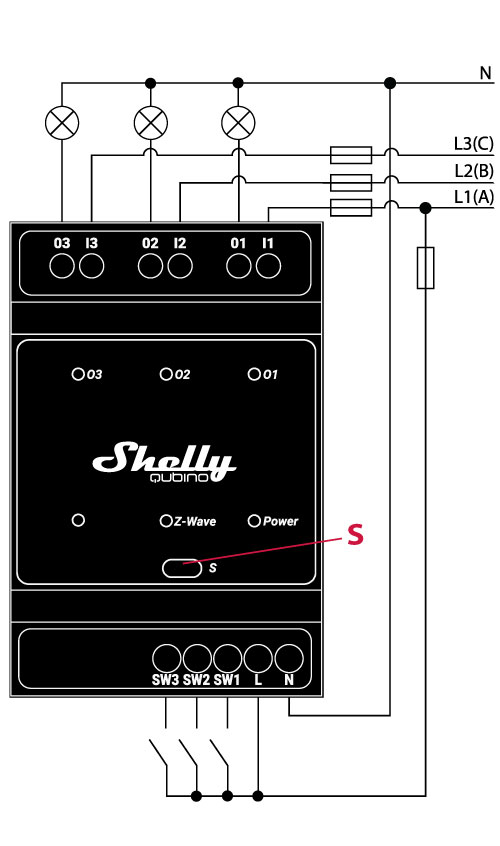
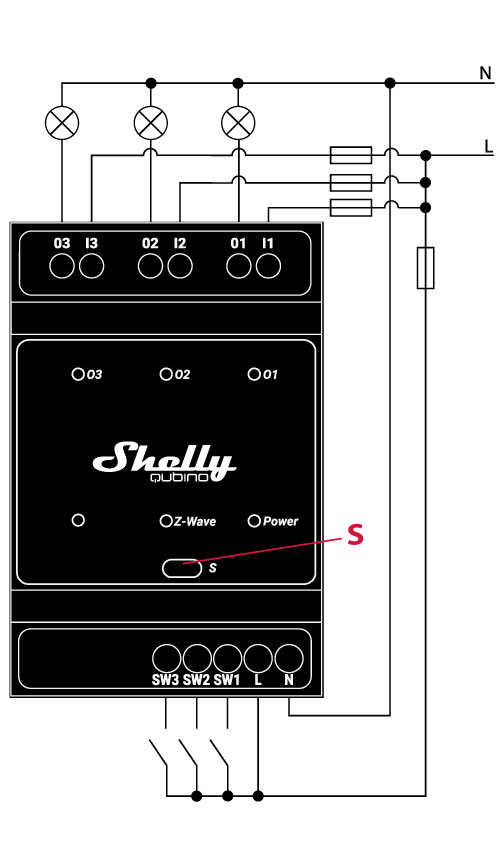
Basic wiring diagram
Fig.1
Fig.2
Legend
Device terminals:
N: Neutral terminal
L: Live terminal(s) (110-240 V AC)
SW (SW1): Switch/push-button input terminal (controlling O (O1))
L1(A): Load circuit phase 1 live wire (110-240 V AC)
L2(B): Load circuit phase 2 live wire (110-240 V AC)
L3(C): Load circuit phase 3 live wire (110-240 V AC)
NOTE: VLL= 400 V ~
Fig.2Wires:
N: Neutral wire
L: Load circuit 1 live wire (110-240 V AC)
L: Load circuit 2 live wire (110-240 V AC)
L: Load circuit 3 live wire (110-240 V AC)
Button:
S: S button
About Z-Wave®
Adding and removing the Device to a Z-Wave® network
Click to see how to add, remove and reset the Device
Adding the Device to a Z-Wave® network (inclusion)
Note! All Device outputs (O, O1, O2, etc. - depending on the Device type) will turn the load 1s on/1s off /1s on/1s off if the Device is successfully added to/removed from a Z-Wave® network.
Note!In case of Security 2 (S2) adding (inclusion), a dialog will appear asking you to enter the corresponding PIN Code (5 underlined digits) that are written on the Z-Wave® DSK label on the side of the Device and on the Z-Wave® DSK label inserted in the packaging. IMPORTANT: The PIN Code must not be lost.
SmartStart adding (inclusion)SmartStart enabled products can be added into a Z-Wave® network by scanning the Z-Wave® QR Code present on the Device with a gateway providing SmartStart inclusion. No further action is required, and the SmartStart device will be added automatically within 10 minutes of being switched on in the network vicinity.With the gateway application scan the QR code on the Device label and add the Security 2 (S2) Device Specific Key (DSK) to the provisioning list in the gateway.Connect the Device to a power supply.Check if the blue LED is blinking in Mode 1. If so, the Device is not added to a Z-Wave® network.Adding will be initiated automatically within a few seconds after connecting the Device to a power supply, and the Device will be added to a Z-Wave® network automatically.The blue LED will be blinking in Mode 2 during the adding process.The green LED will be blinking in Mode 1 if the Device is successfully added to a Z-Wave® network.
Adding (inclusion) with the S button (*not available for Long Range inclusion)Connect the Device to a power supply.Check if the blue LED is blinking in Mode 1. If so, the Device is not added to a Z-Wave® network.Enable add/remove mode on the gateway.To enter the Setting mode, press and hold the S button on the Device until the LED turns solid blue.Release and then press and hold (> 2s) the S button on the Device until the blue LED starts blinking in Mode 3. Releasing the S button will start the Learn mode.The blue LED will be blinking in Mode 2 during the adding process.The green LED will be blinking in Mode 1 if the Device is successfully added to a Z-Wave® network.
Note!In Setting mode, the Device has a timeout of 10s before entering again into Normal mode.
Adding (inclusion) with a switch/push-button (*not available for Long Range inclusion)Connect the Device to a power supply.Check if the blue LED is blinking in Mode 1. If so, the Device is not added to a Z-Wave® network.Enable add/remove mode on the gateway.Toggle the switch/push-button connected to any of the SW terminals (SW, SW1, SW2, etc.) 3 times within 3 seconds (this procedure puts the Device in Learn mode*). The Device must receive on/off signal 3 times, which means pressing the momentary switch 3 times, or toggling the switch on and off 3 times.The blue LED will be blinking in Mode 2 during the adding process.The green LED will be blinking in Mode 1 if the Device is successfully added to a Z-Wave® network.*Learn mode - a state that allows the Device to receive network information from the gateway.
Removing the Device from a Z-Wave® network (exclusion)
Note!The Device will be removed from your Z-Wave® network, but any custom configuration parameters will not be erased.
Note! All Device outputs (O, O1, O2, etc. - depending on the Device type) will turn the load 1s on/1s off /1s on/1s off if the Device is successfully added to/removed from a Z-Wave® network.
Removing (exclusion) with the S buttonConnect the Device to a power supply.Check if the green LED is blinking in Mode 1. If so, the Device is added to a Z-Wave® network.Enable add/remove mode on the gateway.To enter the Setting mode, press and hold the S button on the Device until the LED turns solid blue.Release and then press and hold (> 2s) the S button on the Device until the blue LED starts blinking in Mode 3. Releasing the S button will start the Learn mode.The blue LED will be blinking in Mode 2 during the removing process.The blue LED will be blinking in Mode 1 if the Device is successfully removed from a Z-Wave® network.
Note!In Setting mode, the Device has a timeout of 10s before entering again into Normal mode.
Removing (exclusion) with a switch/push-buttonConnect the Device to a power supply.Check if the green LED is blinking in Mode 1. If so, the Device is added to a Z-Wave® network.Enable add/remove mode on the gateway.Toggle the switch/push-button connected to any of the SW terminals (SW, SW1, SW2,…) 3 times within 3 seconds (this procedure puts the Device in Learn mode). The Device must receive on/off signal 3 times, which means pressing the momentary switch 3 times, or toggling the switch on and off 3 times.The blue LED will be blinking in Mode 2 during the removing process.The blue LED will be blinking in Mode 1 if the Device is successfully removed from a Z-Wave® network.
Factory reset
Factory reset generalAfter Factory reset, all custom parameters and stored values (kWh, associations, routings, etc.) will return to their default state. HOME ID and NODE ID assigned to the Device will be deleted. Use this reset procedure only when the gateway is missing or otherwise inoperable. Factory reset with the S button
Note! Factory reset with the S button is possible anytime.
To enter the Setting mode, press and hold the S button on the Device until the LED turns solid blue.Press the S button multiple times until the LED turns solid red.Press and hold (> 2s) S button on the Device until the red LED starts blinking in Mode 3. Releasing the S button will start the factory reset.During factory reset, the LED will turn solid green for about 1s, then the blue and red LED will start blinking in Mode 3 for approx. 2s.The blue LED will be blinking in Mode 1 if the Factory reset is successful. Factory reset with a switch/push-button
Note!Factory reset with a switch/push-button is only possible within the first minute after the Device is connected to a power supply.
Connect the Device to a power supply.Toggle the switch/push-button connected to any of the SW terminals (SW, SW1, SW2,…) 5 times within 3 seconds. The Device must receive on/off signal 5 times, which means pressing the push-button 5 times, or toggling the switch on and off 5 times.During factory reset, the LED will turn solid green for about 1s, then the blue and red LED will start blinking in Mode 3 for approx. 2s.The blue LED will be blinking in Mode 1 if the Factory reset is successful. Remote factory reset with parameter with a gatewayFactory reset can be done remotely with the settings in Parameter No. 120.
Z-Wave® Security and Device Specific Key (DSK)
Click to see about the Security and the DSK
The Device supports the latest Security 2 (S2) feature. S2 is handled by the Strong AES 128 Encryption protocol, which means that the S2 makes Z-Wave® the most secure IoT (Internet of Things) security platform out there. To fully utilize the product and its Security 2 feature, a Security 2-enabled Z-Wave® gateway must be used.
Authenticated Control
Out-Of-Band DSK for inclusion
May be used by most implementations
The Device also supports Security 2 Authenticated, Unauthenticated, and Unsecure inclusion.
Note! When adding the Device to a Z-Wave® network with a gateway supporting Security 2 (S2), the PIN Code of the Z-Wave® Device Specific Key (DSK) is required. The unique DSK code is printed on the DSK label on the side of the Device and a copy is inserted in the packaging, which must not be lost. Do not remove the DSK label from the product. As a backup measure, use the label in the packaging.
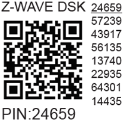
The first five digits of the key are highlighted or underlined to help the user identify the PIN Code part of the DSK text. The DSK is additionally represented with a QR Code as shown on the image.
DSK label and QR code (example)
A joining node requesting to join the S2 Access Control Class or the S2 Authenticated Class will obfuscate its Public Key by setting the bytes 1..2 to zeros (0x00) before transferring its key via RF.
The DSK may be used for out-of-band (OOB) authentication.
The including gateway may use a QR code scanning device to read the entire DSK of the joining device and match it with the obfuscated public key received via RF from the joining device.
Z-Wave® Parameters
Click here to see the Z-Wave Parameters
Parameter No. 1 - SW (SW1) Switch type
This parameter defines how the Device should treat the switch (which type) connected to the SW (SW1) terminal.
Value size: 1 Byte
Default value: 2
Values & descriptions:
0 - momentary switch (push button),
1 - toggle switch (contact closed - ON / contact opened - OFF),
2 - toggle switch (Device changes status when switch changes status)
Parameter No. 2 - SW2 Switch typeThis parameter defines how the Device should treat the switch (which type) connected to the SW2 terminal.Value size: 1 ByteDefault value: 2Values & descriptions:0 - momentary switch (push button), 1 - toggle switch (contact closed - ON / contact opened - OFF), 2 - toggle switch (device changes status when switch changes status)Parameter No. 3 - SW3 Switch typeThis parameter defines how the Device should treat the switch (which type) connected to the SW3 terminal.Value size: 1 ByteDefault value: 2Values & descriptions:0 - momentary switch (push button), 1 - toggle switch (contact closed - ON / contact opened - OFF), 2 - toggle switch (device changes status when switch changes status)
Parameter No. 17 - Restore the O (O1) state after a power failure
This parameter determines if the on/off status is saved and restored for the load connected to O (O1) after a power failure.
Values size: 1 Byte
Default value: 0
Values & descriptions:
0 - Device saves last on/off status and restores it after a power failure
1 - Device does not save on/off status and does not restore it after a power failure, it remains off
NOTE: This functionality does not apply when Parameter 1 is configured with the value "1 - toggle switch (contact closed - ON / contact opened - OFF)"
Parameter No. 18 - Restore the O2 state after a power failure
This parameter determines if the on/off status is saved and restored for the load connected to O2 after a power failure.
Values size: 1 Byte
Default value: 0
Values & descriptions:
0 - Device saves last on/off status and restores it after a power failure
1 - Device does not save on/off status and does not restore it after a power failure, it remains off
Parameter No. 19 - O (O1) Auto OFF with timer
If the load O (O1) is ON, you can schedule it to turn OFF automatically after the period of time defined in this parameter. The timer resets to zero each time the Device receives an ON command, either remotely (from the gateway or associated device) or locally from the switch.
Values size: 2 Byte
Default value: 0
Values & their descriptions:
0 - Auto OFF Disabled
1 - 32535 = 1 - 32535 seconds or milliseconds – see Parameter no. 25. Set timer units to s or ms for O (O1) resolution 100ms
Parameter No. 20 - O (O1) Auto ON with timer
If the load O (O1) is OFF, you can schedule it to turn ON automatically after the period of time defined in this parameter. The timer resets to zero each time the Device receives an OFF command, either remotely (from the gateway or associated device) or locally from the switch.
Values size: 2 Byte
Default value: 0
Values & their descriptions:
0 - Auto ON Disabled
1 - 32535 = 1 - 32535 seconds or milliseconds – see Parameter no. 25. Set timer units to s or ms for O (O1) resolution 100ms
Parameter No. 21 - O2 Auto OFF with timer
If the load O2 is ON, you can schedule it to turn OFF automatically after the period of time defined in this parameter. The timer resets to zero each time the device receives an ON command, either remotely (from the gateway or associated device) or locally from the switch.
Values size: 2 Byte
Default value: 0
Values & their descriptions:
0 - Auto OFF Disabled
1 - 32535 = 1 - 32535 seconds or milliseconds – see Parameter no. 26. Set timer units to s or ms for O2 resolution 100ms
Parameter No. 22 - O2 Auto ON with timer
If the load O2 is OFF, you can schedule it to turn ON automatically after the period of time defined in this parameter. The timer resets to zero each time the device receives an OFF command, either remotely (from the gateway or associated device) or locally from the switch.
Values size: 2 Byte
Default value: 0
Values & their descriptions:
0 - Auto ON Disabled
1 - 32535 = 1 - 32535 seconds or milliseconds – see Parameter no. 26. Set timer units to s or ms for O2 resolution 100ms
Parameter No. 23 - O (O1) contact type - NO/NC
The set value determines the relay contact type for output O (O1). The relay contact type can be normally open (NO) or normally closed (NC).
Values size: 1 Byte
Default value: 0
Values & descriptions:
0 - NO
1 - NC
Relay logic:
Par-NO/NC
Command (switch, Z-Wave…)
Device output state
NO (0)
OFF
OFF (0 V)
NO (0)
ON
ON (230 V)
NC (1)
OFF
ON (230 V)
NC (1)
ON
OFF (0 V)
Parameter No. 24 - O2 contact type - NO/NC
The set value determines the type of Relay contact type for O2 output. The Relay contact type can be normally open (NO) or normally closed (NC).
Values size: 1 Byte
Default value: 0
Values & descriptions:
0 - NO
1 - NC
Relay logic:
par-NO/NC
command (switch, zwave,..)
Device output state
NO (0)
OFF
OFF (0V)
NO (0)
ON
ON (230V)
NC (1)
OFF
ON (230V)
NC (1)
ON
OFF (0V)
Parameter No. 25 - Set timer units to s or ms for O (O1)
Set the timer units to seconds or milliseconds. Choose if you want to set the timer in seconds or milliseconds in Parameters No. 19, 20.
Values size: 1 Byte
Default value: 0
Values & descriptions:
0 – timer set in seconds
1 – timer set in milliseconds
Parameter No. 26 - Set timer units to s or ms for O2Set the timer units to seconds or milliseconds. Choose if you want to set the timer in seconds or milliseconds in Parameters No. 21, 22.Values size: 1 ByteDefault value: 0Values & descriptions:0 – timer set in seconds1 – timer set in millisecondsParameter No. 27 - Restore the O3 state after a power failureThis parameter determines if the on/off status is saved and restored for the load connected to O3 after a power failure.Values size: 1 ByteDefault value: 0Values & descriptions:0 - Device saves last on/off status and restores it after a power failure1 - Device does not save on/off status and does not restore it after a power failure, it remains offParameter No. 29 - O3 Auto OFF with timerIf the load O3 is ON, you can schedule it to turn OFF automatically after the period of time defined in this parameter. The timer resets to zero each time the device receives an ON command, either remotely (from the gateway or associated device) or locally from the switch.Values size: 2 ByteDefault value: 0Values & their descriptions:0 - Auto OFF Disabled1 - 32535 = 1 - 32535 seconds (or milliseconds – see Parameter no. 26. Auto OFF timer enabled for a given amount of seconds (or milliseconds) resolution 100msParameter No. 30 - O3 Auto ON with timerIf the load O3 is OFF, you can schedule it to turn ON automatically after the period of time defined in this parameter. The timer resets to zero each time the device receives an OFF command, either remotely (from the gateway or associated device) or locally from the switch.Values size: 2 ByteDefault value: 0Values & their descriptions:0 - Auto ON Disabled1 - 32535 = 1 - 32535 seconds (or milliseconds – see Parameter no. 26. Auto ON timer enabled for a given amount of seconds (or milliseconds) resolution 100ms
Parameter No. 91 - Water Alarm
This parameter determines how the device should respond to the reports of alarm frames. The parameters consist of 4 bytes, the three most significant bytes are set according to the official Z-Wave protocol specification.
The notification types it reacts to are as followed:
This parameter determines how the device should respond to the reports of alarm frames. The parameters consist of 4 bytes, the three most significant bytes are set according to the official Z-Wave protocol specification.
The notification types it reacts to are as followed:
This parameter determines how the device should respond to the reports of alarm frames. The parameters consist of 4 bytes, the three most significant bytes are set according to the official Z-Wave protocol specification.
The notification types it reacts to are as followed:
This parameter determines how the device should respond to the reports of alarm frames. The parameters consist of 4 bytes, the three most significant bytes are set according to the official Z-Wave protocol specification.
The notification types it reacts to are as followed:
The set value determines the type of Relay contact type for O3 output. The Relay contact type can be normally open (NO) or normally closed (NC).
Values size: 1 Byte
Default value: 0
Values & descriptions:
0 - NO
1 - NC
Relay logic:
par-NO/NC
command (switch, zwave,..)
Device output state
NO (0)
OFF
OFF (0V)
NO (0)
ON
ON (230V)
NC (1)
OFF
ON (230V)
NC (1)
ON
OFF (0V)
Parameter No. 108 - Set timer units to s or ms for O3
Set the timer units to seconds or milliseconds. Choose if you want to set the timer in seconds or milliseconds in Parameters No. 29, 30.
Values size: 1 Byte
Default value: 0
Values & descriptions:
0 – timer set in seconds
1 – timer set in milliseconds
Parameter No. 120 - Factory ResetReset to factory default settings and removed from the Z-Wave network.The parameter is Advanced and may be hidden under the Advanced tag.Values size: 1 ByteDefault value: 0Values & descriptions:0 - No action1 - Factory reset
NOTE: After factory reset is performed, the parameter value is automatically set to 0.
Parameter No. 201 - Serial Number 1This parameter contains a part of device’s serial number.The parameter is Read-Only and cannot be changed.The parameter is Advanced and may be hidden under the Advanced tag.Values size: 4 ByteDefault value: Device specificValues & descriptions:· 0x00000000 - 0x7FFFFFFF Parameter No. 202 - Serial Number 2This parameter contains a part of device’s serial number.The parameter is Read-Only and cannot be changed.The parameter is Advanced and may be hidden under the Advanced tag.Values size: 4 ByteDefault value: Device specificValues & descriptions:· 0x00000000 - 0x7FFFFFFF Parameter No. 203 - Serial Number 3This parameter contains a part of device’s serial number.The parameter is Read-Only and cannot be changed.The parameter is Advanced and may be hidden under the Advanced tag.Values size: 4 ByteDefault value: Device specificValues & descriptions:· 0x00000000 - 0x7FFFFFFF
Z-Wave® Command Classes
Click to see the Z-Wave Command Classes
ASSOCIATION_V2 [S0, S2]*
ASSOCIATION_GRP_INFO_V3 [S0, S2]*
BASIC_V2 [S0, S2]*
SWITCH_BINARY_V2 [S0, S2]*
CONFIGURATION_V4 [S0, S2]*
DEVICE_RESET_LOCALLY_V1 [S0, S2]*
FIRMWARE_UPDATE_MD_V5 [S0, S2]*
INDICATOR_V3 [S0, S2]*
MANUFACTURER_SPECIFIC_V2 [S0, S2]*
MULTI_CHANNEL_V4 [S0, S2]*
MULTI_CHANNEL_ASSOCIATION_V3 [S0, S2]*
NOTIFICATION_V8 [S0, S2]*
POWERLEVEL_V1 [S0, S2]*
SECURITY_V1
SECURITY_2_V1
SUPERVISION_V1
TRANSPORT_SERVICE_V2
VERSION_V3 [S0, S2]*
ZWAVEPLUS_INFO_V2
EndPoint 1
ASSOCIATION_V2 [S0, S2]*
ASSOCIATION_GRP_INFO_V3 [S0, S2]*
BASIC_V2 [S0, S2]*
SWITCH_BINARY_V2 [S0, S2]*
MULTI_CHANNEL_V4 [S0, S2]*
NOTIFICATION_V8 [S0, S2]*
SECURITY_V1
SECURITY_2_V1
SUPERVISION_V1
ZWAVEPLUS_INFO_V2
EndPoint 2
ASSOCIATION_V2 [S0, S2]*
ASSOCIATION_GRP_INFO_V3 [S0, S2]*
BASIC_V2 [S0, S2]*
SWITCH_BINARY_V2 [S0, S2]*
MULTI_CHANNEL_V4 [S0, S2]*
NOTIFICATION_V8 [S0, S2]*
SECURITY_V1
SECURITY_2_V1
SUPERVISION_V1
ZWAVEPLUS_INFO_V2
EndPoint 3
ASSOCIATION_V2 [S0, S2]*
ASSOCIATION_GRP_INFO_V3 [S0, S2]*
BASIC_V2 [S0, S2]*
SWITCH_BINARY_V2 [S0, S2]*
MULTI_CHANNEL_V4 [S0, S2]*
NOTIFICATION_V8 [S0, S2]*
SECURITY_V1
SECURITY_2_V1
SUPERVISION_V1
ZWAVEPLUS_INFO_V2
[S2]* Security S2 Command Class
NOTE: MAPPING OF COMMAND_CLASS_BASIC
Supporting Command Class BasicCOMMAND_CLASS_BASIC is mapped into COMMAND_CLASS_SWITCH_BINARY, for enabling Switch (O) O1, O2,.. control:Switch (O) O1, O2,.. will be turned ON or OFF, after receiving the BASIC_SET command:Basic Command receivedMapped Command (binary Switch)Basic Set (0xFF)Switch binary Switch (0xFF)Basic Set (0x00)Switch binary Switch (0x00)Basic GETBasic Report (Current Value, Target Value) Supporting Command Class IndicatorThe Device supports the Command Class Indicator V3 (ID 0x50). When the Device receives an indicator set, the LED blinks according to the received indicator set.Refer to LED Signalization chapter.
Z-Wave® Notifications Command Class
Click to see the Z-Wave Notification Command Class
Overheat detected
Comment
Overheat detected
Z-Wave Notification Type Name
Heat Alarm
Z-Wave Notification type - Value
0x04
Z-Wave Notification type - Event
State
Z-Wave Notification Name
Overheat detected
Z-Wave Notification Name - Value
0x02
Z-Wave Notification Name - Version
V2
LED signalization
Check LED signalization table
Device reaction - Switch OFF all outputs and send notification
Yes
Action to restore - power cycle
Yes
Action to restore - short press on S button
Yes
Action to restore - press any switch-push button connected to any SW (SW, SW1, SW2, …) terminal
Yes
Z-Wave® Associations
Click to see the Z-Wave Associations
Associations are used for direct communication between the Device and other devices within your Z-Wave network without the need of the Z-Wave gateway.
Max. number of associated devices per group is 9. This value is fixed and cannot be configured.
Each association group supports the association of up to 9 devices (nodes). To avoid network delays, we recommend limiting the number of associated devices to no more than 5 per group. "Lifeline group" is reserved for controlling devices, such as Gateways and remote controllers, or devices who can interpret the reports sent.Association group 1 – "Lifeline group" sends to the controlling device it's command class notifications and or command class reports when said command classes are triggered. Max. 9 nodes are allowed:
Root device Root device - Association Group 1 - Lifeline
INDICATOR_REPORT : LED status
DEVICE_RESET_LOCALLY_NOTIFICATION : triggered upon request
SWITCH_BINARY_REPORT : status change report for all outputs O (O, O1, O2, …) - common
NOTIFICATION_REPORT : triggered on Overheat
Root device - Association Group 2 (*not available for Long Range inclusion) Association Group 2Allowed nodes: 9It is assigned to switch connected to the SW (SW1) terminal (uses Basic command class).Triggered by SW (SW1). The device sends according to the state of SW (SW1) (switch or push-button) the command BASIC_SET ON or BASIC_SET OFF to the associated device. This command is reflected to the output of associated device. Supports the following command classes:BASIC_SET : set On / Off state at the associated device
Root device - Association Group 3 (*not available for Long Range inclusion)
Association Group 3
Allowed nodes: 9
It is assigned to switch connected to the SW (SW1) terminal (uses Switch Multilevel command class). Triggered by SW (SW1).
It is recommended to use push buttons for this association. Supports the following command classes:
SWITCH_MULTILEVEL_START_LEVEL_CHANGE : initiate a transition to a new level (increase or decrease light intensity in case of dimmer, or move shutter up or down, …)
SWITCH_MULTILEVEL_STOP_LEVEL_CHANGE : stop an ongoing transition (stop increase or decrease light intensity in case of dimmer, or stop moving shutter up or down, …)
Root device - Association Group 4 (*not available for Long Range inclusion)
Association Group 4
Allowed nodes: 9
It is assigned to switch connected to the SW2 terminal (uses Basic command class).
Triggered by SW2. Supports the following command classes:
BASIC_SET : set On / Off state at the associated device
Root device - Association Group 5 (*not available for Long Range inclusion)
Association Group 5
Allowed nodes: 9
It is assigned to switch connected to the SW2 terminal (uses Switch Multilevel command class). Triggered by SW2.
It is recommended to use push buttons for this association. Supports the following command classes:
SWITCH_MULTILEVEL_START_LEVEL_CHANGE : initiate a transition to a new level (increase or decrease light intensity in case of dimmer, or move shutter up or down, …)
SWITCH_MULTILEVEL_STOP_LEVEL_CHANGE : stop an ongoing transition (stop increase or decrease light intensity in case of dimmer, or stop moving shutter up or down, …)
Root device - Association Group 6 (*not available for Long Range inclusion)
Association Group 6
Allowed nodes: 9
It is assigned to switch connected to the SW3 terminal (uses Basic command class).
Triggered by SW3. Supports the following command classes:
BASIC_SET : set On / Off state at the associated device
Root device - Association Group 7 (*not available for Long Range inclusion)
Association Group 7
Allowed nodes: 9
It is assigned to switch connected to the SW3 terminal (uses Switch Multilevel command class). Triggered by SW3
It is recommended to use push buttons for this association. Supports the following command classes:
SWITCH_MULTILEVEL_START_LEVEL_CHANGE : initiate a transition to a new level (increase or decrease light intensity in case of dimmer, or move shutter up or down, …)
SWITCH_MULTILEVEL_STOP_LEVEL_CHANGE : stop an ongoing transition (stop increase or decrease light intensity in case of dimmer, or stop moving shutter up or down, …)
Endpoint 1
Endpoint 1 - Association Group 1 - Lifeline
SWITCH_BINARY_REPORT : status change report for output O (O1)
Association Group 2
Allowed nodes: 9
It is assigned to switch connected to the SW (SW1) terminal (uses Basic command class).
Triggered by SW (SW1). The device sends according to the state of SW (SW1) (switch or push-button) the command BASIC_SET ON or BASIC_SET OFF to the associated device. This command is reflected to the output of associated device. Supports the following command classes:
BASIC_SET : set On / Off state at the associated device
Association Group 3
Allowed nodes: 9
It is assigned to switch connected to the SW (SW1) terminal (uses Switch Multilevel command class). Triggered by SW (SW1).
It is recommended to use push buttons for this association. Supports the following command classes:
SWITCH_MULTILEVEL_START_LEVEL_CHANGE : initiate a transition to a new level (increase or decrease light intensity in case of dimmer, or move shutter up or down, …)
SWITCH_MULTILEVEL_STOP_LEVEL_CHANGE : stop an ongoing transition (stop increase or decrease light intensity in case of dimmer, or stop moving shutter up or down, …)
Endpoint 2
Endpoint 2 - Association Group 1 - Lifeline
SWITCH_BINARY_REPORT : status change report for output O2
Association Group 2Allowed nodes: 9It is assigned to switch connected to the SW2 terminal (uses Basic command class).Triggered by SW2. The device sends according to the state of SW2 (switch or push-button) the command BASIC_SET ON or BASIC_SET OFF to the associated device. Supports the following command classes:BASIC_SET : set On / Off state at the associated deviceAssociation Group 3Allowed nodes: 9It is assigned to switch connected to the SW2 terminal (uses Switch Multilevel command class). Triggered by SW2. It is recommended to use push buttons for this association. Supports the following command classes:SWITCH_MULTILEVEL_START_LEVEL_CHANGE : initiate a transition to a new level (increase or decrease light intensity in case of dimmer, or move shutter up or down, …)SWITCH_MULTILEVEL_STOP_LEVEL_CHANGE : stop an ongoing transition (stop increase or decrease light intensity in case of dimmer, or stop moving shutter up or down, …)
Endpoint 3 Endpoint 3 - Association Group 1 - Lifeline
SWITCH_BINARY_REPORT : status change report for output O3
Association Group 2
Allowed nodes: 9
It is assigned to switch connected to the SW3 terminal (uses Basic command class).
Triggered by SW3. The device sends according to the state of SW3 (switch or push-button) the command BASIC_SET ON or BASIC_SET OFF to the associated device.Supports the following command classes:
BASIC_SET : set On / Off state at the associated device
Association Group 3
Allowed nodes: 9
It is assigned to switch connected to the SW3 terminal (uses Switch Multilevel command class). Triggered by SW3.
It is recommended to use push buttons for this association. Supports the following command classes:
SWITCH_MULTILEVEL_START_LEVEL_CHANGE : initiate a transition to a new level (increase or decrease light intensity in case of dimmer, or move shutter up or down, …)
SWITCH_MULTILEVEL_STOP_LEVEL_CHANGE : stop an ongoing transition (stop increase or decrease light intensity in case of dimmer, or stop moving shutter up or down, …)
Z-Wave® Important disclaimer
Z-Wave® wireless communication may not always be 100% reliable. This Device should not be used in situations in which life and/or valuables are solely dependent on its functioning. If the Device is not recognized by your gateway or appears incorrectly, you may need to change the Device type manually and ensure that your gateway supports Z-Wave Plus™ multi-level devices.
Troubleshooting
For troubleshooting please visit our support portal: Support